
Feed

Page 11 of 27

Erik Craddock@eriklink

The quality of AI-assisted software depends on unit of work management - nilenso blog

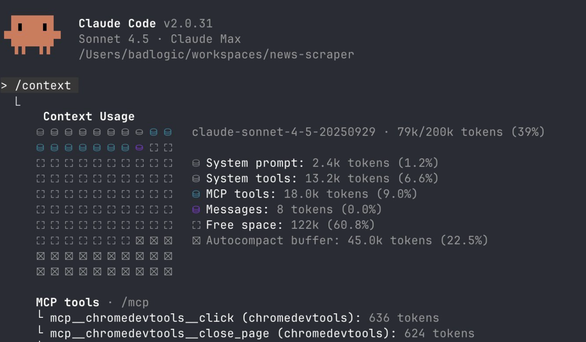
The best AI-assisted craftsmen are often thinking about the design and arrangement of their context to get the AI to one-shot a solution. This is tricky and effortful, contrary to what the AI coding hype suggests.

If you don’t provide the necessary information in the context to do a good job, your AI will hallucinate or generate code that is not congruent with the practices of your codebase. It is especially brittle at integration points of your software system.

On the other hand, if you fill up the context with too much information, and the quality of your output degrades, because of a lack of focused attention.

The quality of AI-assisted software depends on unit of work management - nilenso blog

nilenso blog

The quality of AI-assisted software depends on unit of work management - nilenso blog

...

linkby Erik Craddock (@erik)Credit: nilenso
Erik Craddock@eriklink

The Technium: The Trust Quotient (TQ)

Right now, AIs own no responsibilities. If they get things wrong, they don’t guarantee to fix it. They take no responsibility for the trouble they may cause with their errors. In fact, this difference is currently the key difference between human employees and AI workers. The buck stops with the humans. They take responsibility for their work; you hire humans because you trust them to get the job done right. If it isn’t, they redo it, and they learn how to not make that mistake again. Not so with current AIs. This makes them hard to trust.

Every company, and probably every person, will have an AI agent that represents them inside the AI system to other AI agents. Making sure your personal rep agent has a high trust score will be part of your responsibility. It is a little bit like a credit score for AI agents. You will want a high TQ for yours. Because some AI agents won’t engage with other agents having low TQs. This is not the same thing as having a personal social score (like the Chinese are reputed to have). This is not your score, but the TQ score of your agent, which represents you to other agents. You could have a robust social score reputation, but your agent could be lousy. And vice versa.

The Technium: The Trust Quotient (TQ)

The Technium

The Technium: The Trust Quotient (TQ)

linkby Erik Craddock (@erik)Credit: Kevin Kelly
Erik Craddock@eriklink

anti-patterns and patterns for achieving secure generation of code via AI

If you think that you can achieve security through offering guidance to the LLM through cursor rules, then you are misguided. Cursor rules or any of those types of rules (i.e AGENTS.md) that are attached to your agentic coding harness are mere suggestions to the LLM. They are suggestions.

anti-patterns and patterns for achieving secure generation of code via AI

Geoffrey Huntley

anti-patterns and patterns for achieving secure generation of code via AI

linkby Erik Craddock (@erik)Credit: Geoffrey Huntley
Erik Craddock@eriklink

When You Stop Loving What You Do

AI seems to be accelerating this feeling, at least with many of my friends. There is a sense of malaise and frustration at what appears to be the slow erosion of intentional care and effort in our industry. Just let the AI do it, while you ... do other stuff.

I'm not quite there yet. I believe you can use AI as a virtual assistant that does the stuff that actually causes burnout in the first place. Creating and updating READMEs, ensuring the code on your docs is correct, writing a script that compiles markdown to a PDF - things like that.

When You Stop Loving What You Do

a.bigmachine.io

When You Stop Loving What You Do

linkby Erik Craddock (@erik)
Erik Craddock@eriklink

This blog has a comment system | justin․searls․co

I had not thought of it this way but I love the idea and it is very true and feels right. I often create posts that are just links to stuff I read on the internet. Typically I don't write any comment at all. I simply quote the relevant part of the link.

Here's how to leave a comment on this web site:

  1. Read a post
  2. Think, "I want to comment on this"
  3. Draft a post on your blog
  4. Add a hyperlink to my post
  5. Paste an excerpt to which you want to respond
  6. Write your comment
  7. Hit publish
This blog has a comment system | justin․searls․co

justin․searls․co

This blog has a comment system | justin․searls․co

so, if you're off social media and your blog doesn't have a comment section"

linkby Erik Craddock (@erik)Credit: Justin Searls
Erik Craddock@eriklink

The Technium: Emotional Agents

Many people have found the intelligence of AIs to be shocking. This will seem quaint compared to a far bigger shock coming: highly emotional AIs. The arrival of synthetic emotions will unleash disruption, outrage, disturbance, confusion, and cultural shock in human society that will dwarf the fuss over synthetic intelligence. In the coming years the story headlines will shift from “everyone will lose their job” (they won’t) to “AI partners are the end of civilization as we know it.”

The Technium: Emotional Agents

The Technium

The Technium: Emotional Agents

linkby Erik Craddock (@erik)Credit: Kevin Kelly
Erik Craddock@eriklink

AI Can't Read Your Docs

The core principle is simple: reduce the need for external context and assumptions. An AI agent is at its best when the next step is obvious and the tools are intuitive. This framework builds from the most immediate agent interaction all the way up to the complete system architecture. This isn’t to say today's agents can’t reason or do complex things. But to unlock the full potential of today’s models—to not just solve problems, but do so consistently—these are your levers.

AI Can't Read Your Docs

Shrivu’s Substack

AI Can't Read Your Docs

Designing software that today's AI coding agents can actually use.

linkby Erik Craddock (@erik)Credit: Shrivu Shankar