Feed

Page 1 of 28

Erik Craddock@eriklink

First Principles Thinking

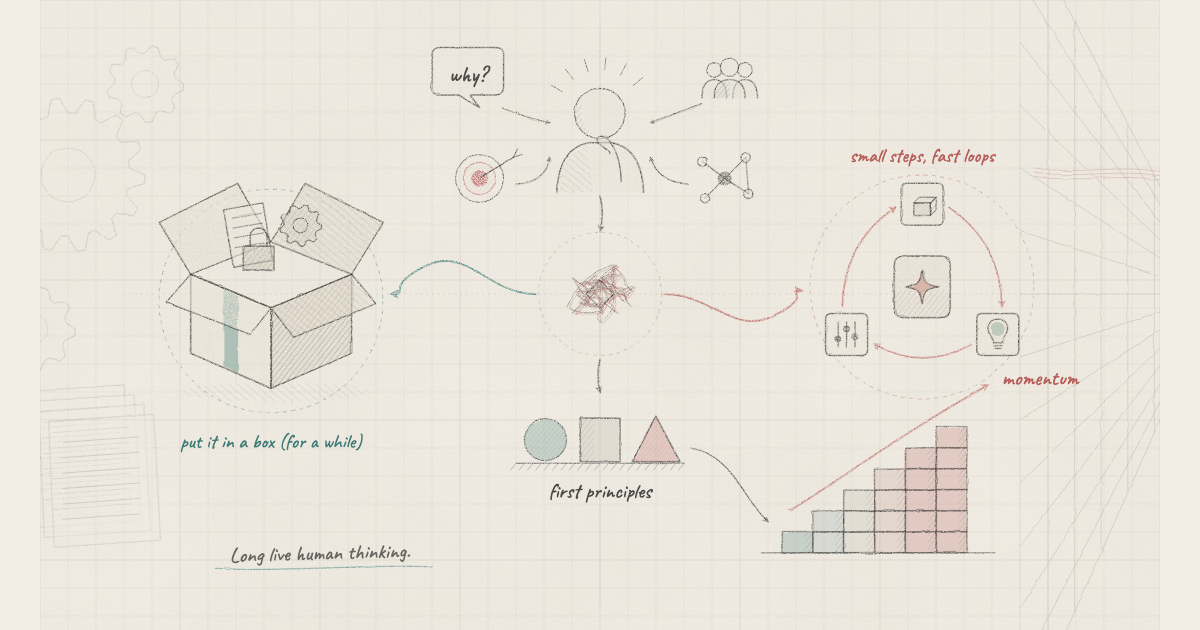
That brings me back to the momentum Pai describes. First principles thinking makes working that way feel natural. When you truly understand what you’re trying to accomplish, it’s easier to take a small step, learn from it, and keep going. If you’re doing it right, working with agents lets that back-and-forth happen much faster. You get faster learning loops and more momentum, oriented around deep understanding. To me, that’s the new flow state.

First Principles Thinking

Sunil Sadasivan

First Principles Thinking

On first principles thinking, learning to work with agents, and setting experience aside long enough to see a problem clearly.

linkby Erik Craddock (@erik)Credit: Sunil Sadasivan
Erik Craddock@eriklink

You should all be asking way more questions

There will probably come a day when I always get sensible answers to these questions that convince me the model knows what it’s doing. But today is not that day. About half the questions I ask get answers that convince me3 the model has made a mistake

Sean Goedecke

You should all be asking way more questions

Asking frequent, specific questions exposes misunderstandings and design mistakes—whether you’re working with other engineers or AI agents.

linkby Erik Craddock (@erik)Credit: Sean Goedecke
Erik Craddock@eriklink

Why Personal Websites Are Coming Back

The personal website is coming back because people are rediscovering something the early Web made obvious: the Internet is more interesting when individuals have places of their own. We spent roughly twenty years moving into a handful of very large apartment buildings. Some people are starting to build houses again.

Why Personal Websites Are Coming Back

Dead Parrot BBS

Why Personal Websites Are Coming Back

Personal websites are attracting renewed interest as people rediscover owning a domain, controlling their work, and building an Internet outside large platforms.

linkby Erik Craddock (@erik)Credit: nickb
Erik Craddock@eriklink

They really do think AI might kill everyone

Whatever else you say about the AI doomers, they have more than two decades’ history of explicitly spelling out exactly what they believe and why, even when it was complete science fiction to talk about AI at all. They’ve earned the right to be treated as sincere.

Sean Goedecke

They really do think AI might kill everyone

Sean Goedecke argues that many AI researchers sincerely believe AI poses an existential risk, explaining their reasoning and why they continue building it.

linkby Erik Craddock (@erik)Credit: Sean Goedecke
Erik Craddock@eriklink

Astra for Coding: Why Are We Doing This Again?

In fact, with Astra and Fable I feel like not only are the costs astronomical, but the models are also just not for me as a software engineer. And presumably that’s because these models increasingly are for other people. For lawyers, 3D artists, mathematicians, whoever uses computer use, etc.

Astra for Coding: Why Are We Doing This Again?

Armin Ronacher’s Thoughts and Writings

Astra for Coding: Why Are We Doing This Again?

Some thoughts on Astra and newfangled long-horizon models.

linkby Erik Craddock (@erik)Credit: Armin Ronacher
Erik Craddock@eriklink

Why we should anthropomorphize AI agents

it is not even obvious that AIs aren’t conscious! People often dismiss this point by diagnosing it (to my mind, the absolute worst way to argue against anything), or by pointing at some philosophical theory that suggests it might be impossible in principle to construct artificial sentient minds.

I think we are asking the wrong question. Maybe the question should be, are humans obviously conscious?

Sean Goedecke

Why we should anthropomorphize AI agents

Treating AI agents as human-like can better explain and predict their behavior without assuming they are conscious or absolving AI companies of responsibility.

linkby Erik Craddock (@erik)Credit: Sean Goedecke
Erik Craddock@eriklink

You have to beat the models at something

Staying ahead of the models is a moving target. At the start of 2026, “make working changes to large codebases” was in this category, but now it’s not. For this reason, I doubt that you can retreat to some “hard engineering” area that requires deeper expertise. That might work in the short term, but not forever. If LLMs can find a better lower bound on the Riemann hypothesis, they will soon1 be able to write solid high-performance kernel drivers or GPU shaders or whatever.

Sean Goedecke

You have to beat the models at something

Software engineers need durable advantages over AI coding models, especially deep codebase familiarity and clear technical communication.

linkby Erik Craddock (@erik)Credit: Sean Goedecke
Erik Craddock@eriklink

An end to fully open networks

We’re going to need to create a cost for the sender (so it can’t scale to ridiculous) as well as an identity layer (so scammers can’t be fully anonymous–reputation is earned, not invented). It might be an open protocol in the spirit of the best parts of the net, or it might be a single monopolist that figures out how to extract value from it.

An end to fully open networks

Seth’s Blog

An end to fully open networks

Open communication networks like phone and email cannot survive AI-scaled spam without sender costs and identity/reputation layers.

linkby Erik Craddock (@erik)Credit: Seth Godin

Page 1 of 28