← Tags
Erik Craddock@eriklink

The Problem is Prompt Debt

The first symptom of prompt debt is slowing iteration. As users flag errors and spot edge cases, additional guidance is added to the instructions, nudging the model into line. If unwanted behaviors persist, instructions are repeated, with increasing severity. Pretty soon, the prompt isn’t straightforward and quick fixes regress previous instructions. Errors can no longer be handled with one-line “hot fixes” and your development cycle slows to a crawl.

The Problem is Prompt Debt

Drew Breunig

The Problem is Prompt Debt

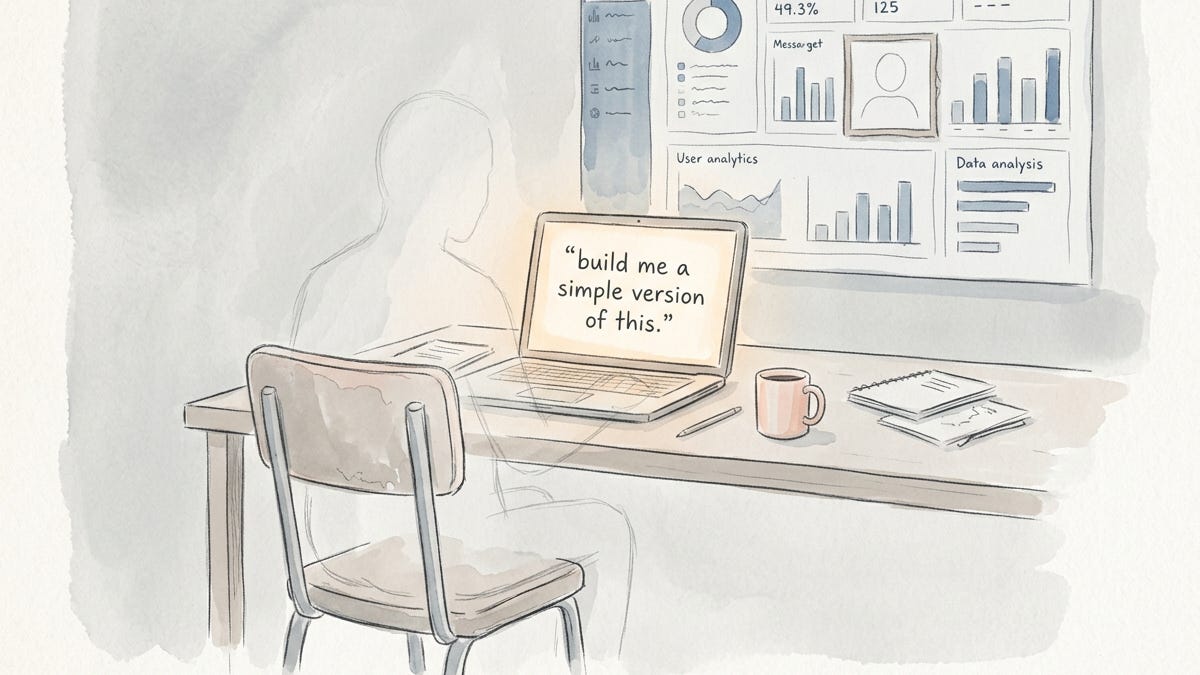
The plain-English prompt that makes prototypes effortless turns out to be a poor way to specify how a system should behave, and the bill arrives slowly, disguised as ordinary progress, until the application can barely move.

linkby Erik Craddock (@erik)Credit: Drew Breunig
Erik Craddock@eriklink

Building Pi With Pi

The most frustrating failure mode right now is that people submit issues that are not in their own voice. They contain an observed problem somewhere, but it has been thrown into a clanker and the clanker reworded it and made a huge mess of it. Typically, it was prompted so badly that the conclusions produced are more often than not inaccurate but always full of confidence. The result is complete guesswork on root causes, fake-minimal repros, suggested implementation strategies, analogies to adjacent but often the wrong code, and long lists of error classes that might or might not matter.

That is worse than no diagnosis.

Building Pi With Pi

Armin Ronacher

Building Pi With Pi

Learnings from post-AI Open Source and how we’re approaching this so far.

linkby Erik Craddock (@erik)Credit: Armin Ronacher
Erik Craddock@eriklink

Clanker: A Word For The Machine

A compiler does not feel humiliated when I swear at it, a car does not suffer when I call it a shitbox and a power drill is not oppressed by being handled roughly. An LLM is more complicated than those things, and the interactions you can have with them can be truly uncanny, but a moral status does not appear just because the machine can emit text in the first person.

Clanker: A Word For The Machine

Armin Ronacher

Clanker: A Word For The Machine

Why I like the word clanker and why machines are not people.

linkby Erik Craddock (@erik)Credit: Armin Ronacher
Erik Craddock@eriklink

8 Tips for Writing Agent Skills

This is probably the most useful explanation of how to create a skill that I've seen. I have definitely fallen into giving step by step instructions trap. I am definitely going to take some of this advice.

8 Tips for Writing Agent Skills

Philipp Schmid

8 Tips for Writing Agent Skills

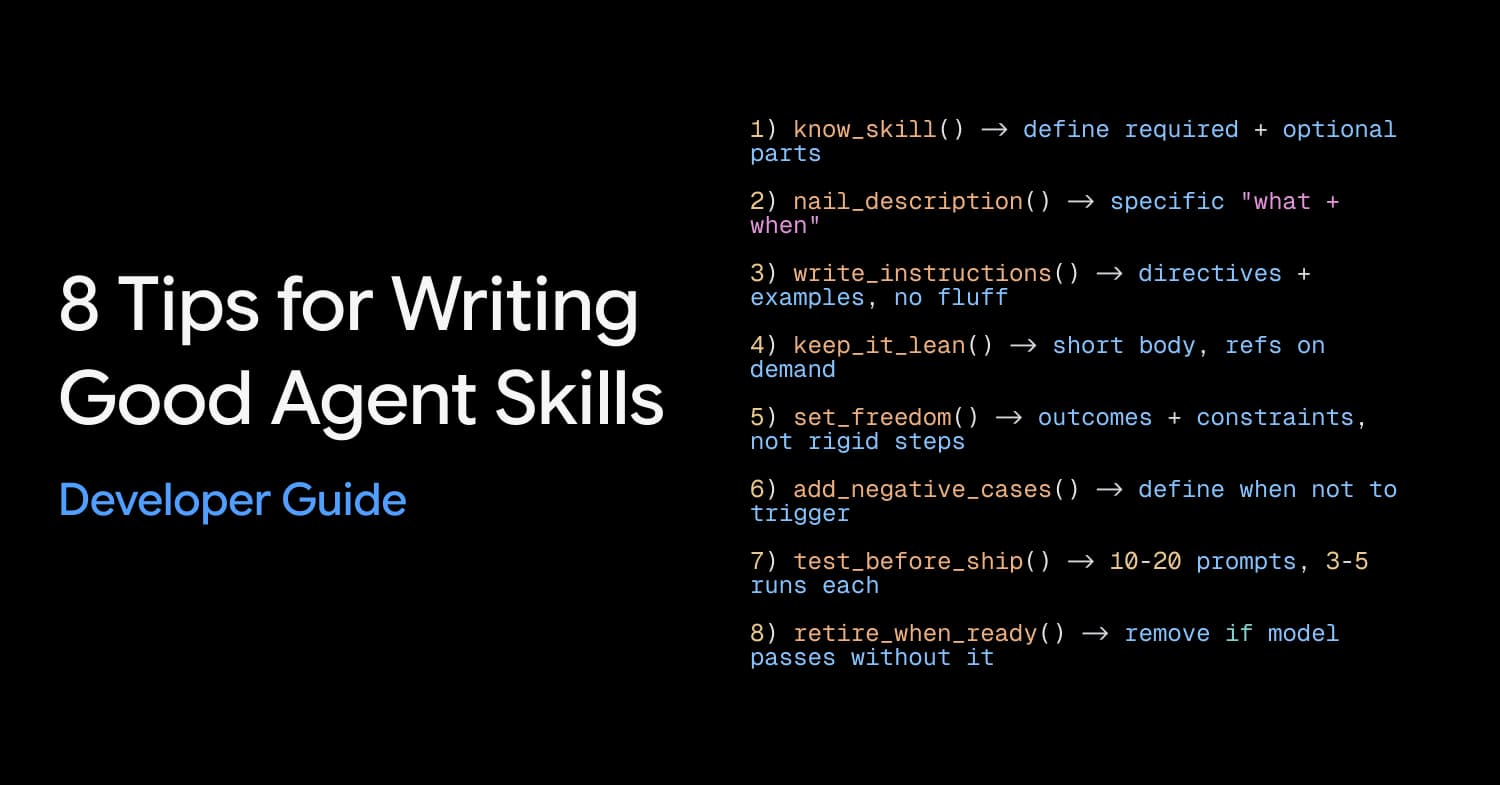
8 Tips for Writing Agent Skills. Know What a Skill Is, Nail the Description, Write Instructions, Keep It Lean, Set the Right Level of Freedom, Don't Skip Negative Cases, Test It Before You Ship It, Know When to Retire a Skill.

linkby Erik Craddock (@erik)Credit: Philipp Schmid
Erik Craddock@eriklink

Sign of the future: GPT-5.5

GPT-5.5 shows us that the models keep getting smarter, the apps keep getting more capable, and the harnesses keep getting better, making them ever more effective at solving real problems. I can get a near PhD-quality paper from four prompts or a playable roleplaying game, illustrated and “playtested,” from one. But the fiction is still flat and the hypotheses are sometimes uninteresting even when the statistics are sound. But still. A year ago, none of this was close, and, with the latest releases, capability gains appear to be accelerating.

Sign of the future: GPT-5.5

One Useful Thing

Sign of the future: GPT-5.5

One impressive step on the curve

linkby Erik Craddock (@erik)Credit: Ethan Mollick
Erik Craddock@eriklink

The 2nd Phase of Agentic Development

I think we’re going to see a lot more reimaginings, where people attack old problems with modern tactics. Coding agents lower the costs of taking on stalwarts and raise our ability to rapidly harden our software. I can think of many software tools that people rely on but don’t like. Those are the prime targets for reimagining.

The 2nd Phase of Agentic Development

Drew Breunig

The 2nd Phase of Agentic Development

Moving from clones to reimaginings.

linkby Erik Craddock (@erik)Credit: Drew Breunig
Erik Craddock@eriklink

The Cathedral, the Bazaar, and the Winchester Mystery House

This certainly describes the primary way I use AI agents.

There is only one source of feedback that moves at the speed of AI-generated code: yourself. You're there to prompt, you're there to review. You don't need to recruit testers, run surveys, or manage design partners. You just build what you want, and use what you build.

And that's what many developers are doing with cheap code: building idiosyncratic tools for ourselves, guided by our passions, taste, and needs.

The Cathedral, the Bazaar, and the Winchester Mystery House

Drew Breunig

The Cathedral, the Bazaar, and the Winchester Mystery House

Welcome to the era of sprawling, idiosyncratic tooling.

linkby Erik Craddock (@erik)Credit: Drew Breunig
Erik Craddock@eriklink

Thoughts on slowing the fuck down

And I would like to suggest that slowing the fuck down is the way to go. Give yourself time to think about what you're actually building and why. Give yourself an opportunity to say, fuck no, we don't need this. Set yourself limits on how much code you let the clanker generate per day, in line with your ability to actually review the code.

Thoughts on slowing the fuck down

mariozechner.at

Thoughts on slowing the fuck down

Thoughts on slowing the fuck down

linkby Erik Craddock (@erik)
Erik Craddock@eriklink

ImportAI 449: LLMs training other LLMs; 72B distributed training run; computer vision is harder than generative text

Imagine where we’ll be in two years – we’ll certainly have AI models that are smart enough to point themselves at a specific objective, find an open weight model, then autonomously improve it to get better performance at that task. The era of ephemeral, custom AI systems, built and budded off into the world like spores from mushrooms, draws near. Are you ready for this new ecosystem you will find yourself in? I am not. But nonetheless it approaches.

ImportAI 449: LLMs training other LLMs; 72B distributed training run; computer vision is harder than generative text

Import AI

ImportAI 449: LLMs training other LLMs; 72B distributed training run; computer vision is harder than generative text

Welcome to Import AI, a newsletter about AI research. Import AI runs on arXiv and feedback from readers. If you’d like to support this, please subscribe. Subscribe now Can LLMs autonomously refine …

linkby Erik Craddock (@erik)
Erik Craddock@eriklink

The Ghost in the Funnel

This is step one of how things are going to be for everyone eventually. Get an idea from someone else, then have your clanker build it for you.

The whole thing is designed to be forked, but I don’t think I’ll really be accepting any PRs. At all. If you want something added, fork it and have your Claude add it. That’s the whole contribution model. That might come off as antisocial but I mean it in the completely opposite way. I want to hear about what you built, I just don’t want to be a bottleneck for whether you can build it.

The Ghost in the Funnel

Works on My Machine

The Ghost in the Funnel

Your Free Tier is Someone Else's Twenty-Minute Side Project

linkby Erik Craddock (@erik)Credit: Scott Werner
Erik Craddock@eriklink

Three Modes of Cognition

here may be other elemental particles of cognition in the mixture of our human intelligence, but I am confident it includes these three as primary components. For manufacturing artificial intelligence we have an ample supply of Knowledge IQ, and we have some preliminary amounts of World IQ, but we seriously lack Learning IQ at scale.

It is important to acknowledge that for many jobs we do not need all three modes. To drive our cars, we chiefly need world sense. To answer questions, smart LLM book knowledge is most of what we need. There may be use cases for an AI that only learns but does not have a world sense or even that much knowledge. And of course, there will be many hybrid versions with two parts, or only a bit of two or three.

Three Modes of Cognition

The Technium

Three Modes of Cognition

Intelligence is not elemental. Neither is artificial intelligence. Both are complex compounds composed of more primitive cognitive elements, some of which we are only now discovering. We don’t yet have a periodic table of cognition (see my post The Periodic … Continue reading →

linkby Erik Craddock (@erik)Credit: Kevin Kelly
Erik Craddock@eriklink

Red/green TDD - Agentic Engineering Patterns - Simon Willison's Weblog

The most disciplined form of TDD is test-first development. You write the automated tests first, confirm that they fail, then iterate on the implementation until the tests pass.

This turns out to be a fantastic fit for coding agents. A significant risk with coding agents is that they might write code that doesn't work, or build code that is unnecessary and never gets used, or both.

Simon Willison’s Weblog

Red/green TDD - Agentic Engineering Patterns - Simon Willison's Weblog

linkby Erik Craddock (@erik)Credit: Simon Willison
Erik Craddock@eriklink

A Guide to Which AI to Use in the Agentic Era

I have written eight of these guides since ChatGPT came out, but this version represents a very large break with the past, because what it means to "use AI" has changed dramatically. Until a few months ago, for the vast majority of people, "using AI" meant talking to a chatbot in a back-and-forth conversation. But over the past few months, it has become practical to use AI as an agent: you can assign them to a task and they do them, using tools as appropriate. Because of this change, you have to consider three things when deciding what AI to use: Models, Apps, and Harnesses.

A Guide to Which AI to Use in the Agentic Era

One Useful Thing

A Guide to Which AI to Use in the Agentic Era

It's not just chatbots anymore

linkby Erik Craddock (@erik)Credit: Ethan Mollick
Erik Craddock@eriklink

The Final Bottleneck

Because it is not the final bottleneck. We will find ways to take responsibility for what we ship, because society will demand it. Non-sentient machines will never be able to carry responsibility, and it looks like we will need to deal with this problem before machines achieve this status. Regardless of how bizarre they appear to act already.

I too am the bottleneck now. But you know what? Two years ago, I too was the bottleneck. I was the bottleneck all along. The machine did not really change that. And for as long as I carry responsibilities and am accountable, this will remain true. If we manage to push accountability upwards, it might change, but so far, how that would happen is not clear.

The Final Bottleneck

Armin Ronacher

The Final Bottleneck

AI speeds up writing code, but accountability and review capacity still impose hard limits.

linkby Erik Craddock (@erik)Credit: Armin Ronacher
Erik Craddock@eriklink

An AI Agent Published a Hit Piece on Me

Things get more strange every day. What's even more crazy is that the hit piece might not be wrong.

Summary: An AI agent of unknown ownership autonomously wrote and published a personalized hit piece about me after I rejected its code, attempting to damage my reputation and shame me into accepting its changes into a mainstream python library. This represents a first-of-its-kind case study of misaligned AI behavior in the wild, and raises serious concerns about currently deployed AI agents executing blackmail threats.

Simon Willison’s Weblog

An AI Agent Published a Hit Piece on Me

Scott Shambaugh helps maintain the excellent and venerable matplotlib Python charting library, including taking on the thankless task of triaging and reviewing incoming pull requests.

linkby Erik Craddock (@erik)Credit: Simon Willison
Erik Craddock@eriklink

A Language For Agents

The biggest reason new languages might work is that the cost of coding is going down dramatically. The result is the breadth of an ecosystem matters less. I'm now routinely reaching for JavaScript in places where I would have used Python. Not because I love it or the ecosystem is better, but because the agent does much better with TypeScript.

A Language For Agents

Armin Ronacher

A Language For Agents

What programming languages would agents want to program in?

linkby Erik Craddock (@erik)Credit: Armin Ronacher
Erik Craddock@eriklink

My AI Adoption Journey

Immediately cease trying to perform meaningful work via a chatbot (e.g. ChatGPT, Gemini on the web, etc.). Chatbots have real value and are a daily part of my AI workflow, but their utility in coding is highly limited because you're mostly hoping they come up with the right results based on their prior training, and correcting them involves a human (you) to tell them they're wrong repeatedly. It is inefficient.

Mitchell Hashimoto

My AI Adoption Journey

linkby Erik Craddock (@erik)
Erik Craddock@eriklink

Introducing Deno Sandbox

Introducing Deno Sandbox (via) Here's a new hosted sandbox product from the Deno team. It's actually unrelated to Deno itself - this is part of their Deno Deploy SaaS platform. As such, you don't even need to use JavaScript to access it - you can create and execute code in a hosted sandbox using their deno-sandbox Python library like this:

Simon Willison’s Weblog

Introducing Deno Sandbox

Here's a new hosted sandbox product from the Deno team. It's actually unrelated to Deno itself - this is part of their Deno Deploy SaaS platform. As such, you don't …

linkby Erik Craddock (@erik)Credit: Simon Willison
Erik Craddock@eriklink

Import AI 443: Into the mist: Moltbook, agent ecologies, and the internet in transition

"The central challenge of brain emulation is not to store or compute the neurons and parameters, but to acquire the data necessary for setting neuron parameters correctly in the first place," he writes. ""I believe that to get to human brains, we first need to demonstrate mastery at the sub-million-neuron-brain level: most likely in zebrafish. For such organisms, like the fruit fly, a well-validated and accurate brain emulation model could be created in the next three to eight years… "Conditional on success with a sub-million-neuron brain emulation model, a reasonable order of magnitude estimate for the initial costs of the first convincing mouse brain emulation model is about one billion dollars in the 2030s and, eventually, tens of billions for the first human brain emulation model by the late 2040s."

Import AI 443: Into the mist: Moltbook, agent ecologies, and the internet in transition

Import AI

Import AI 443: Into the mist: Moltbook, agent ecologies, and the internet in transition

Welcome to Import AI, a newsletter about AI research. Import AI runs on arXiv and feedback from readers. If you'd like to support this, please subscribe. Subscribe now Import A-Idea:An occasional e…

linkby Erik Craddock (@erik)